

Snowflake makes it easy to create a database, load data, and run a query. That speed can hide architectural decisions that become expensive later.
A proof of concept can use one account, one warehouse, and broad roles. In production, that design creates predictable problems: workloads compete, sensitive data spreads, ownership becomes unclear, and compute spend is difficult to attribute.
A production-ready Snowflake architecture is defined by the quality of its boundaries, not its size.
Those boundaries should answer four questions:
- Where can a workload make changes?
- Which version of the data is authoritative?
- Who can access or administer each object?
- Which compute resources and costs belong to each workload?
This guide presents a practical reference architecture for answering them early.
Start With Isolation, Not Object Names
Snowflake organizes securable objects in a hierarchy: an organization contains accounts, accounts contain databases, databases contain schemas, and schemas contain objects such as tables, views, stages, and functions.
Each level creates a different kind of boundary.
|
Boundary |
Best used for |
What it isolates |
|
Account |
Regulatory, regional, business, or strong environment separation |
Users, roles, account policies, metadata, and most administrative operations |
|
Database |
Data products, domains, or lifecycle boundaries |
Data ownership, cloning, replication, retention, and database roles |
|
Schema |
Processing layers or related object groups |
Object namespaces, creation privileges, and centralized grant management |
|
Warehouse |
Workload-specific compute |
Performance, concurrency, operational impact, and compute attribution |
These levels are not interchangeable. A schema named PROD inside a development account does not provide the isolation of a production account. Conversely, creating a database for every source table adds complexity without creating a useful business boundary.
The design depends on risk. A regulated enterprise may require an account per environment; a smaller team may separate non-production and production. In either case, production changes need a controlled path, and experimental work must not compete with production.
Choose an Environment Strategy Deliberately
There are three common patterns for environment isolation.
Pattern 1: One Account, Multiple Databases
Development, test, and production are represented by databases in one account.
This is simple to operate, and zero-copy cloning makes non-production copies easy. However, account configuration and administration remain shared, giving mistakes a larger blast radius.
Use this pattern for small teams with modest compliance requirements and mature deployment controls. Do not rely on naming alone. Separate roles and warehouses must enforce the environment boundaries.
Pattern 2: Non-Production and Production Accounts
Development and test share a non-production account, while production uses a dedicated account.
This is a strong default. Production has an independent security and operational boundary, while deployment automation promotes tested changes across accounts.
This pattern balances isolation with administrative overhead and is the reference model used in this article.
Pattern 3: Separate Accounts for Development, Test, and Production
Each environment receives its own account.
This provides the strongest separation and supports different policies, controls, administrators, regions, and editions. It requires mature automation to keep definitions, grants, and configuration consistent.
Use it when regulatory requirements, team boundaries, regional deployment, or operational risk justify the additional management surface.
|
Requirement |
One account |
Non-prod + prod |
Account per environment |
|
Low administrative overhead |
Strong |
Moderate |
Weak |
|
Production isolation |
Weak |
Strong |
Strongest |
|
Independent account policies |
No |
Yes |
Yes |
|
Simple cloning across environments |
Strong |
Moderate |
Moderate |
|
Suitable for strict compliance |
Rarely |
Often |
Usually |
Organize Data by Responsibility
Inside each environment, data should move through layers with distinct responsibilities. The familiar raw, refined, and consumption model remains useful because it prevents ingestion behavior, transformation logic, and reporting contracts from becoming entangled.
Raw Layer
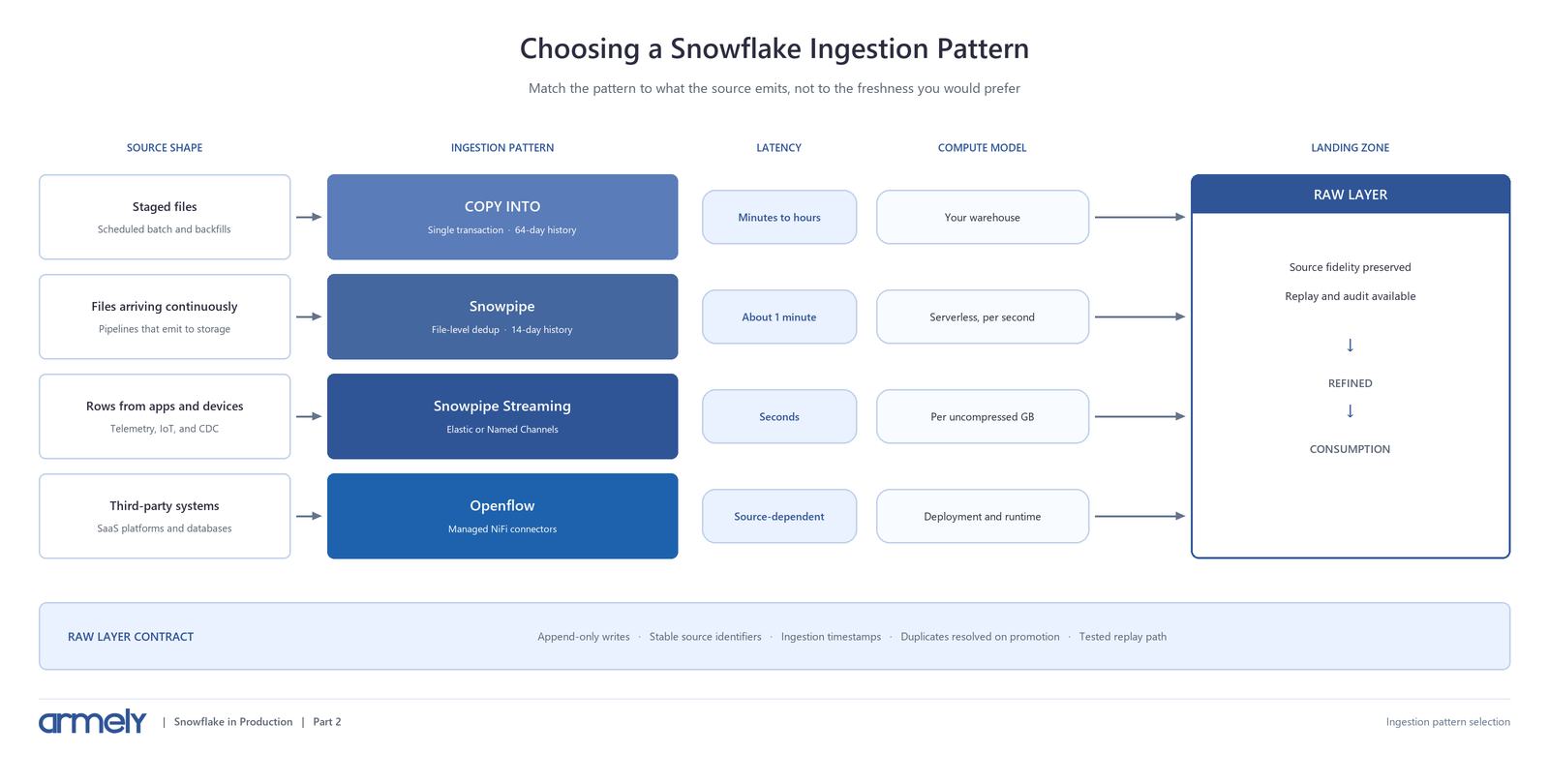
The raw layer preserves data close to the form in which it arrived. It provides replayability, auditability, and a stable point from which pipelines can recover.
Typical contents include staged source extracts, append-only ingestion tables, source metadata, and load audit fields. Transformations in this layer should be limited to what is required to load and trace the data.
Raw does not mean uncontrolled. Sensitive fields still require access restrictions, retention policies, and appropriate encryption and network controls.
Refined Layer
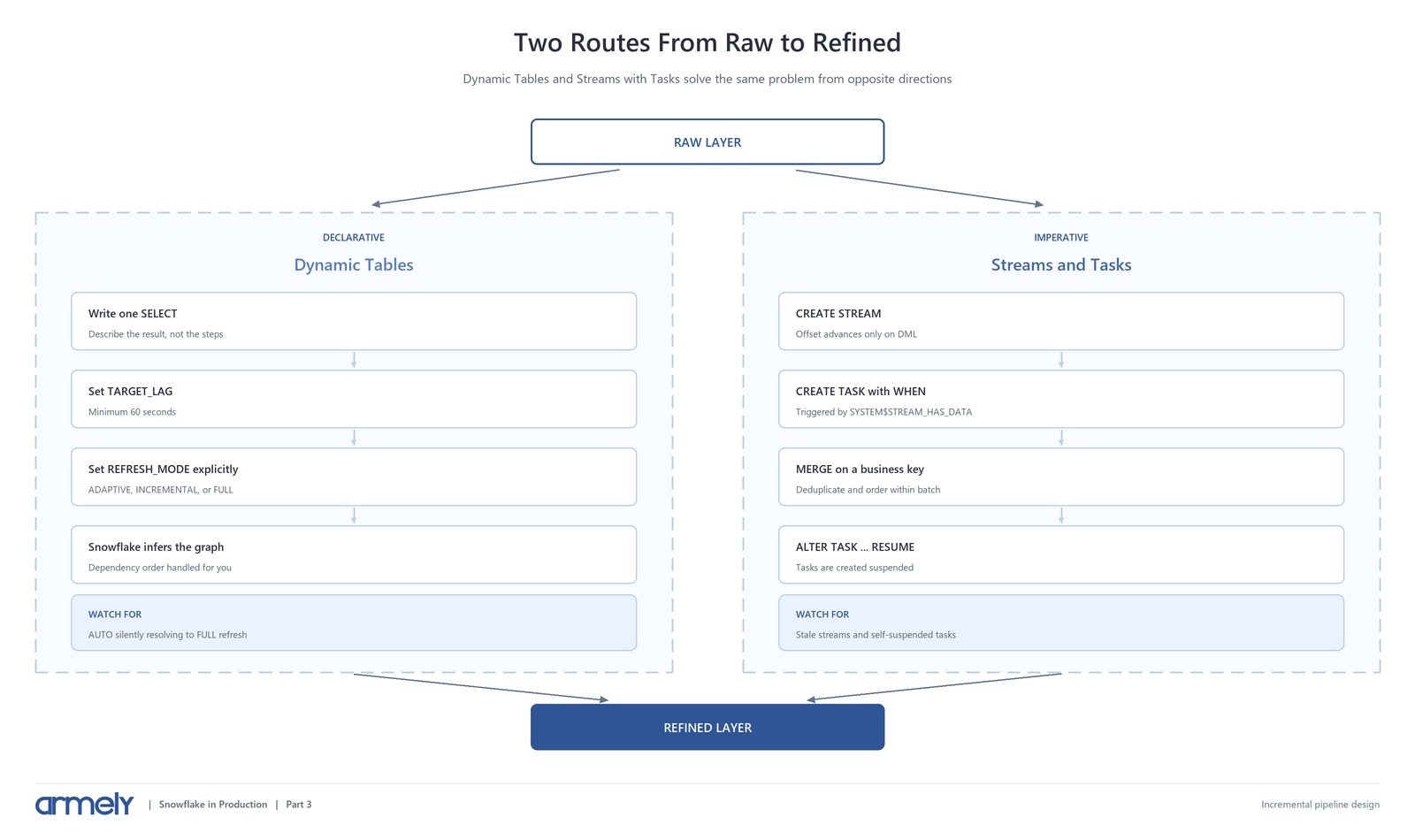
The refined layer applies durable engineering rules: type conversion, deduplication, standardization, conformed keys, and quality checks.
Tables here should support reuse. If every team independently cleans identifiers or resolves late records, the platform has storage but no shared data architecture.
Consumption Layer
The consumption layer exposes data for a defined use case. It can contain dimensional models, secure views, feature tables, application-facing datasets, or governed data products.
Business definitions specific to a reporting or operational contract belong here. Consumers should not reconstruct current records from raw events.
A practical database layout might look like this:
|
SALES_RAW |
Using separate databases for layers gives teams clear ownership and lifecycle controls. For a smaller domain, one database with managed access schemas named RAW, REFINED, and CONSUMPTION may be sufficient. Choose the database boundary when the layer requires independent ownership, sharing, replication, or retention behavior.
Separate Compute by Workload
Snowflake separates storage from compute, but workloads are isolated only when the architecture assigns them to appropriate virtual warehouses.
Putting ingestion, transformation, ad hoc exploration, and BI traffic on one warehouse creates three problems:
- A large transformation can queue dashboard queries.
- Warehouse sizing becomes a compromise between unrelated workloads.
- Compute cost cannot be attributed cleanly to a team or purpose.
A better baseline uses dedicated warehouses:
|
Warehouse |
Workload |
Starting approach |
|
INGEST_WH |
File loading and ingestion operations |
Small, aggressive auto-suspend |
|
TRANSFORM_WH |
Scheduled SQL transformations |
Size from measured batch duration |
|
BI_WH |
Dashboards and governed analytics |
Size for latency; scale out for concurrency |
|
DATA_SCIENCE_WH |
Exploration or Snowpark SQL workloads |
Isolate variable or memory-intensive work |
|
ADMIN_WH |
Occasional administrative queries |
X-Small, short auto-suspend |
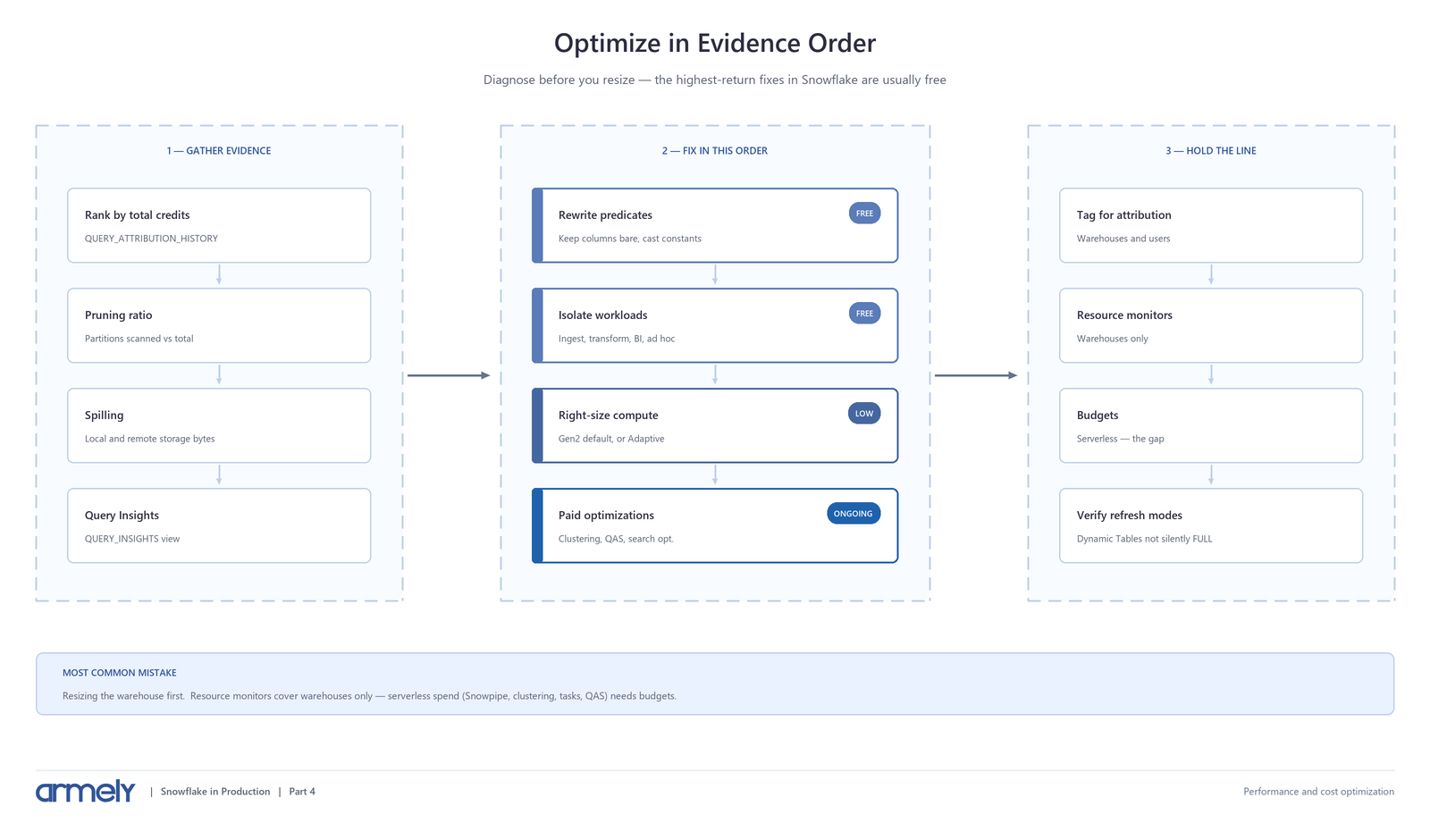
Warehouse size and cluster count solve different problems. Scaling up provides more resources to process large, complex queries. Scaling out with a multi-cluster warehouse addresses concurrency by adding clusters when queries would otherwise queue.
Start with measured behavior rather than the largest affordable size. Larger warehouses cost more and do not guarantee proportional improvement for small queries or file loads.
Auto-suspend should reflect workload cadence. Snowflake bills a 60-second minimum when compute is provisioned and then bills per second. A timeout below normal query gaps can cause repeated restarts, while leaving an intermittent warehouse running wastes credits. Five minutes or less is a useful test point; production values should come from observed query patterns.
|
CREATE WAREHOUSE IF NOT EXISTS BI_WH |
Every warehouse should have a named owner, approved consumer roles, a resource monitor or budget control, and a review process for size or cluster changes.
Design Access Around Functions, Not People
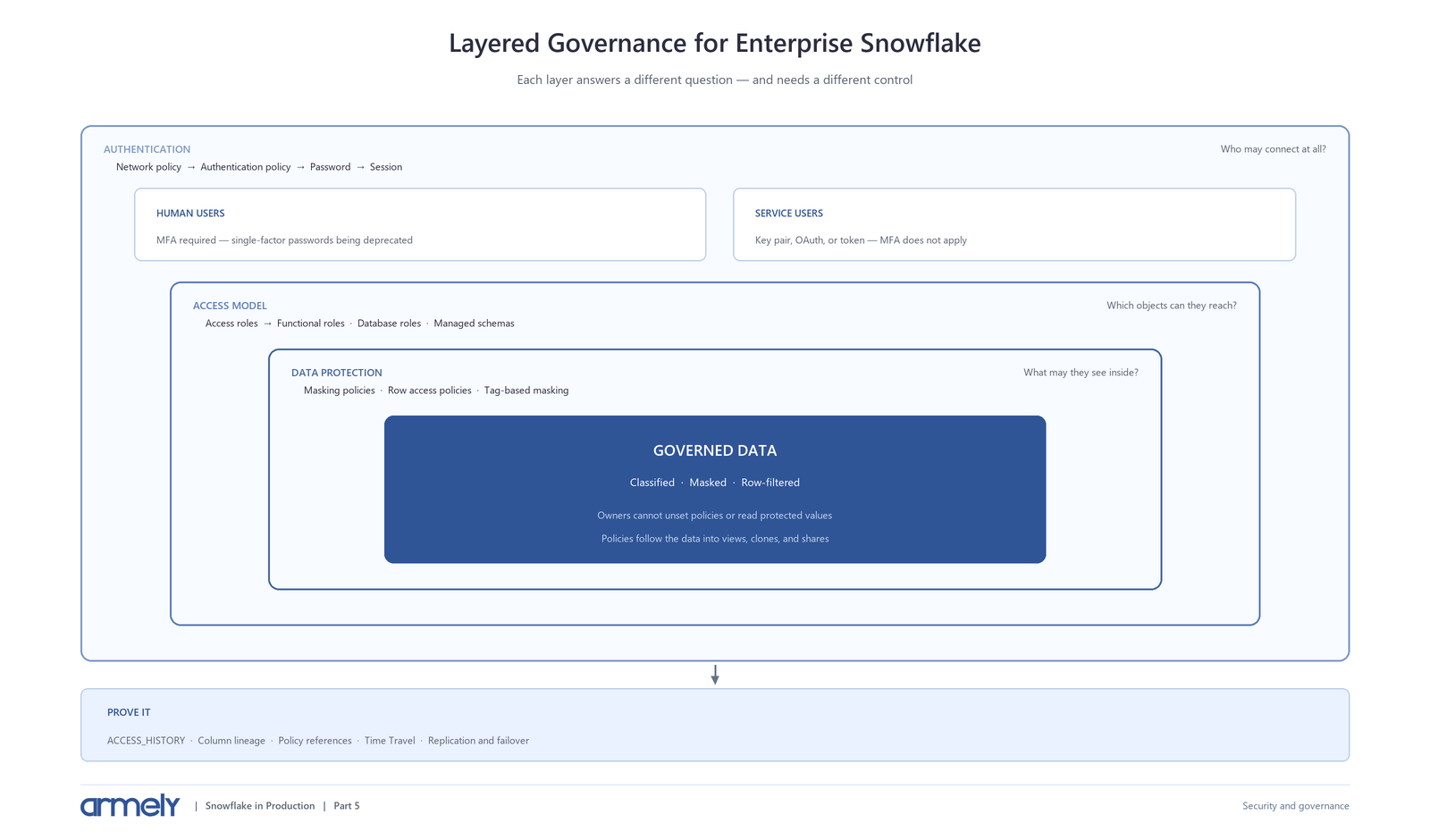
Production authorization should be role-based. Direct grants to individual users are difficult to review, reproduce, and revoke consistently.
A scalable Snowflake role model separates two concerns:
- Access roles hold privileges on data or warehouses.
- Functional roles represent what a person or service does.
For example, SALES_ANALYTICS_READER may hold USAGE and SELECT privileges for the analytics database. The functional role SALES_ANALYST inherits that access role and receives usage on BI_WH. Users receive the functional role rather than a collection of object grants.
|
USE ROLE USERADMIN; |
For larger estates, database roles can package privileges within a database and then be granted to account-level functional roles. This allows database owners to manage access locally without turning every data grant into an account-wide role.
Use managed access schemas where centralized grant decisions matter. In a managed access schema, individual object owners cannot independently grant access; the schema owner or a role with MANAGE GRANTS controls privileges. Future grants then ensure new tables and views receive the intended access automatically.
ACCOUNTADMIN should be reserved for limited account-level administration. It should not own application objects, serve as a user's default role, or run automated pipelines.
Reference Architecture
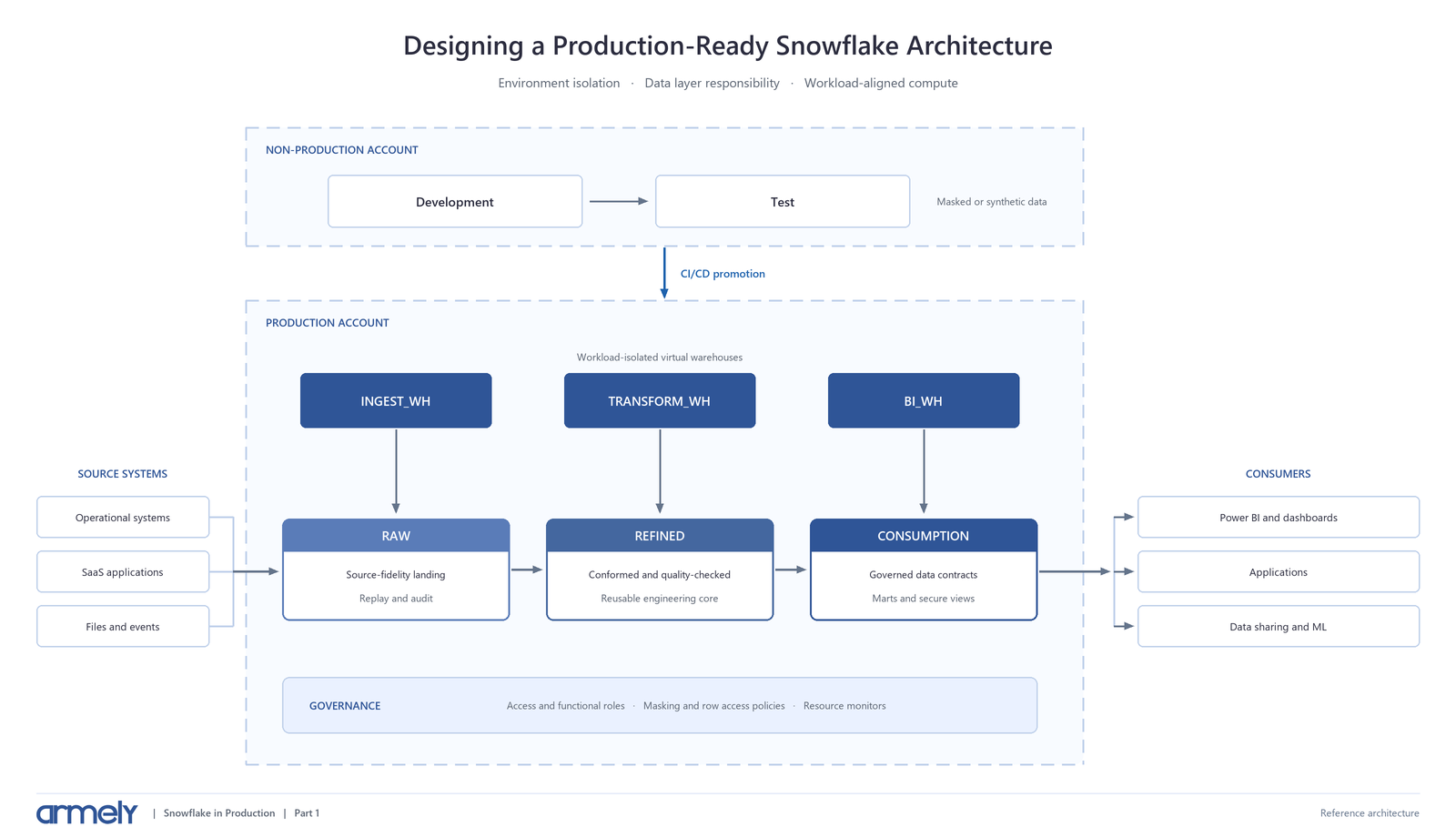
The following model separates production from non-production, organizes data by responsibility, and assigns compute by workload.
Reference Snowflake production architecture
|
SOURCE SYSTEMS |
DEPLOYMENT PATH |
CONSUMERS |
|
Operational systems |
Non-production account |
Power BI |
|
DATA PATH -> |
CI/CD promotion |
<- GOVERNED ACCESS |
|
|
Production account |
|
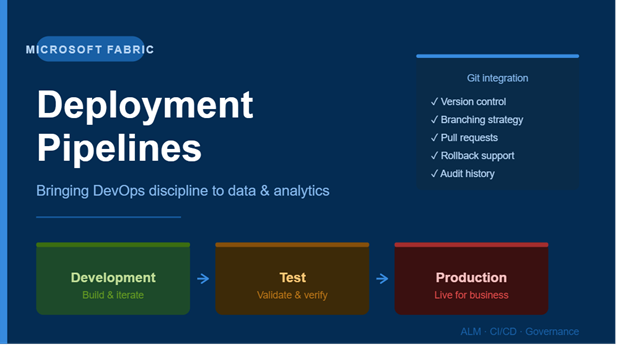
The deployment path is separate from the data path. Code moves from development to test to production through CI/CD. Production data moves from source ingestion through raw, refined, and consumption layers. Mixing these paths, for example by cloning manually modified development objects into production, weakens reproducibility.
For development and testing, use masked or synthetic datasets where possible. A zero-copy clone remains governed by the sensitivity of the data it exposes.
Common Architecture Failures
One Warehouse for Everything
This looks efficient until one workload affects another. Separate warehouses first by operational behavior and ownership, then tune their size using query history and load evidence.
Environment Names Without Enforced Boundaries
Names such as DEV_SCHEMA and PROD_SCHEMA do not stop a role from changing both. Enforce separation through accounts or databases, role grants, ownership, and automated deployment identities.
Reporting Directly From Raw Data
This pushes deduplication, data quality rules, and business logic into every dashboard. Publish stable consumption contracts instead.
Grants Made to Individual Users
Person-specific grants accumulate silently and make access reviews unreliable. Grant privileges to access roles and assign functional roles to users and service identities.
Using ACCOUNTADMIN for Routine Work
Objects inherit ownership from the active primary role that creates them. Creating ordinary objects with ACCOUNTADMIN produces an ownership model that is difficult to delegate cleanly and grants automated processes unnecessary power.
Treating Cloning as Deployment
Cloning is valuable for testing and recovery, but it is not a substitute for version-controlled DDL, repeatable grants, and promotion pipelines.
Production Readiness Checklist
Before onboarding the first critical workload, confirm the following:
Environment and Deployment
- Production has an explicit isolation boundary supported by risk requirements.
- Infrastructure, SQL objects, and grants are deployed from version control.
- Production changes use a dedicated deployment identity and approved role.
- Non-production access to sensitive data is masked, minimized, or synthetic.
Data Organization
- Raw, refined, and consumption responsibilities are documented.
- Each database and schema has a named owner and lifecycle policy.
- Ingestion metadata supports traceability and replay.
- Consumers query governed contracts instead of reconstructing raw events.
Compute
- Ingestion, transformation, BI, and experimental workloads use intentional warehouse assignments.
- Auto-suspend and auto-resume values reflect measured usage patterns.
- Warehouse sizing is based on query duration, queueing, and cost evidence.
- Resource monitors or budgets and cost attribution tags are configured.
Security
- Users receive functional roles rather than direct object grants.
- Access roles contain object privileges and follow least privilege.
- Custom role hierarchies ultimately connect to SYSADMIN where appropriate.
- Managed access schemas and future grants are used for governed areas.
- ACCOUNTADMIN is limited, protected with MFA, and excluded from automation.
- Service identities use dedicated roles and authentication policies.
Operations
- Query, warehouse, login, and access activity is monitored.
- Recovery objectives and Time Travel retention are defined by data tier.
- Ownership exists for failed loads, data quality incidents, and cost anomalies.
- Architecture decisions and exceptions are reviewed on a schedule.
Practical Recommendation
For most organizations beginning a Snowflake production implementation, start with two accounts: one for non-production and one for production. Organize production data into raw, refined, and consumption boundaries. Give ingestion, transformation, analytics, and experimental workloads separate warehouses. Build access from reusable data roles into business-functional roles and promote every production change from version control.
This design is intentionally uncomplicated. Its value is not the number of objects it creates, but the questions it makes easy to answer: where data came from, who can use it, which workload changed it, and what that workload costs.
Snowflake can scale compute quickly. A production architecture must also scale ownership, governance, and trust.
Planning or modernizing a Snowflake platform? Armely helps organizations design secure, cost-aware data architectures that remain operable as workloads and teams grow. Explore Armely's data services or contact our team.
Technical review sources: