
Microsoft FABRIC. Now in PREVIEW. Data & AI
If you've ever asked why your marketing team's definition of "Customer" doesn't match finance's, or why your AI assistant confidently gives the wrong answer -- you already understand the problem that Microsoft Fabric IQ was built to solve.
Announced as a preview workload within Microsoft Fabric, IQ is a bold step toward something the data industry has promised for years but rarely delivered: a single, consistent semantic layer that every tool, every agent, and every team can trust. This insight paper explores what Fabric IQ is, the problems it solves, and why now is the moment to act.
01 -- What Is It?
The Unified Intelligence Layer
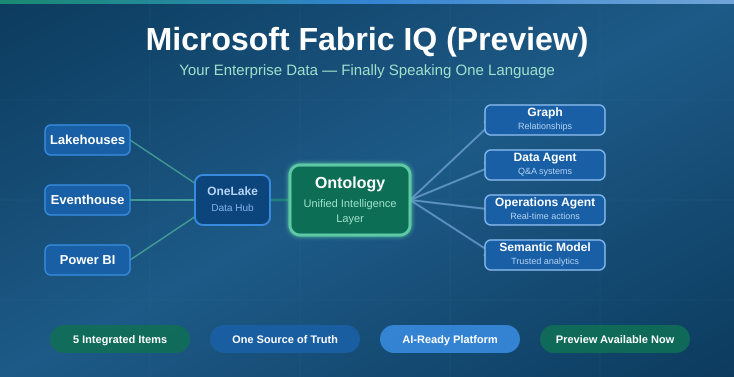
Fabric IQ is a collection of tightly integrated items designed to model your enterprise's vocabulary and expose it consistently across analytics, AI, and operational systems. Think of it less like a product and more like connective tissue -- binding your OneLake data (Lakehouses, Eventhouse, Power BI models) to a shared understanding of what that data actually means.
At its core, IQ centers on an Ontology -- a formal definition of your business entities, their properties, and how they relate. Once defined, that ontology powers everything else: graph traversals, AI agent grounding, Power BI semantic consistency, and real-time operational monitoring.
|
"A concept like 'Customer' should be defined once -- and understood everywhere." |
The Five Items That Power Fabric IQ
Each item within the IQ workload plays a distinct role, and together they form a unified capability that connects data, semantics, analysis, and AI-driven action:
|
IQ Item |
What It Does |
Best Use Case |
|
Ontology |
The enterprise vocabulary layer. Defines entity types, relationships, properties, rules, and constraints -- bound to real OneLake data, so every downstream tool shares the same language and meaning. |
Cross-domain consistency, AI agent grounding, governance, semantic unification |
|
Graph |
Native graph storage and compute for nodes, edges, and traversals over connected data. Integrates with Ontology to visually represent and query your business concept relationships. |
Impact chains, dependency analysis, path finding, community detection, relationship-heavy decisions |
|
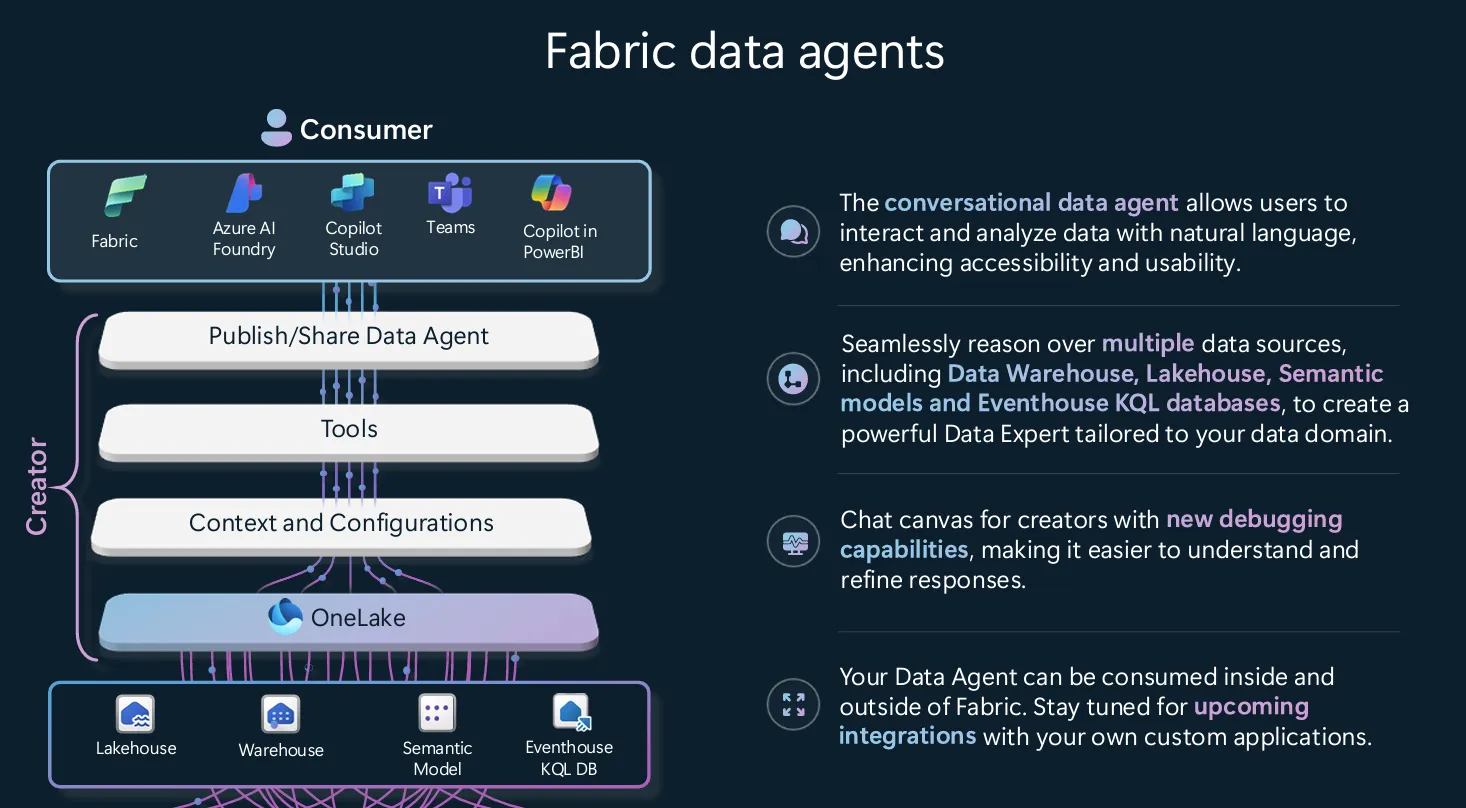
Data Agent |
Build conversational Q&A systems grounded in your ontology using generative AI. Agents understand your actual business terms and definitions when answering questions. |
AI copilots, self-service analytics, ontology-aware enterprise chatbots |
|
Operations Agent |
AI agent that monitors real-time data streams and recommends business actions -- fully aware of your business concepts, terminology, and governance rules. |
Real-time operational intelligence, alerting, safe and auditable action recommendations |
|
Power BI Semantic Model |
Curated analytics models for trusted KPIs, dashboards, and self-service BI. Ontologies can be generated directly from semantic models to keep language consistent across all Fabric experiences. |
Governed reporting, dimensional modeling, business intelligence, DAX calculations |
02 -- Why Now?
The Problem It Solves
Most enterprises today are running on a patchwork of data definitions, and the consequences are felt everywhere -- in every meeting room, every dashboard review, every AI deployment. The problem isn't a lack of data. Organizations have more data than ever. The problem is that no two teams define that data the same way.
Sales calls a "deal" something Finance calls an "opportunity." One team's "active user" excludes trial accounts; another's doesn't. The result? Dashboards that contradict each other, AI copilots that hallucinate business logic, and onboarding processes that take months instead of days. New data engineers spend weeks mapping undocumented conventions. AI agents give fluent answers built on wrong foundations.
|
Data governance isn't just about access control. It's about shared meaning -- and Fabric IQ makes that meaning enforceable, versioned, and trustworthy. |
Fabric IQ attacks this directly. By making the ontology the single source of truth -- a first-class Fabric item that can be versioned, validated, governed, and monitored -- organizations can finally break the cycle of definitional duplication and tribal knowledge that undermines data-driven decision making.
The Business Cost of Semantic Fragmentation
The cost of undefined or duplicated business concepts isn't always visible in a single dashboard. It compounds across the organization:
- Analytics reports that conflict with each other, eroding trust in data across the business
- AI agents that produce technically fluent but contextually incorrect answers, leading to disengagement
- Onboarding timelines that stretch to weeks or months because business rules live in people's heads, not systems
- Data quality issues that are caught downstream in reports rather than upstream at the semantic layer
- Duplicated effort as each team rebuilds the same definitions in their own tools and models
With Fabric IQ, these costs don't disappear overnight -- but they do have a path to resolution. Define once. Use everywhere. Govern centrally.
03 -- Choosing the Right Tool
What Goes Where
IQ exists alongside other Fabric workloads, and the right item depends on your scenario. Understanding where each capability fits is key to designing the right architecture for your organization:
|
Item |
When to Use |
|
Ontology (IQ) |
Use when you need cross-domain semantic consistency, governance, and AI agent grounding, and you want to reason across business processes. This is the foundational item for any organization building governed, AI-ready data infrastructure. |
|
Graph (IQ / RTI) |
Use when relationship-heavy questions dominate your decision making -- impact chains, community detection, shortest paths -- and you need graph-native query performance at scale. |
|
Power BI Semantic Model |
Use when business users need trusted KPIs, fast interactive visuals, dimensional modeling, calculations, and governed datasets for self-service BI. Semantic models and ontologies are complementary, not competing. |
|
Digital Twin Builder (RTI) |
Use when you need operational context tied to real physical assets, stateful twin simulation, scenario analysis, or what-if modelling connected to live IoT signals and operational data streams. |
It is also worth noting that several Fabric IQ items are shared with other Fabric workloads. Graph appears in both IQ and Real-Time Intelligence. Data Agent is also part of Data Science. Operations Agent is also part of Real-Time Intelligence. This reflects Fabric's broader composable architecture -- items are available wherever they are relevant, not siloed within a single workload.
04 -- The Big Picture
AI That Actually Knows Your Business
Perhaps the most compelling promise of Fabric IQ is what it enables for AI agents -- and it is worth examining carefully, because the gap between the promise of enterprise AI and its current reality is wider than most organizations admit.
Current enterprise AI deployments often suffer from a fundamental flaw: the models are powerful, but they don't understand your specific business context. They don't know that your "Tier 1 Customer" classification has a specific revenue threshold, or that a "Cold Chain Breach" has regulatory consequences, or that "active user" means something different to product and finance. They answer with fluency and confidence -- but without contextual accuracy. And over time, teams learn to distrust them.
|
The gap between what AI can do and what it does in your organization is almost always a data semantics problem -- not a model capability problem. Fabric IQ closes that gap. |
With Fabric IQ, your ontology becomes the grounding layer for agents. Business rules and constraints live in the ontology -- which means agents can move beyond generating answers to recommending and triggering safe, auditable actions. Actions that reflect your enterprise language. Actions that are traceable to defined business logic. Actions that governance teams can audit.
That's not just a feature improvement. That's the bridge between analytical AI -- which tells you what happened -- and operational AI -- which recommends and executes what should happen next. Fabric IQ is that bridge, and it is available now.
How Items Work Together
The real power of Fabric IQ emerges when its items operate in combination:
- Ontology + Power BI Semantic Model: Define enterprise concepts like Customer, Shipment, and KPI once. Generate or align semantic models from the ontology so that terminology and KPI definitions stay consistent across all reports and dashboards.
- Ontology + Graph: The ontology declares which things connect and why. Graph stores and computes the traversals -- 'Find all shipments exposed to risky routes and surface related Cold Chain Breaches.' These items integrate natively in the IQ workload.
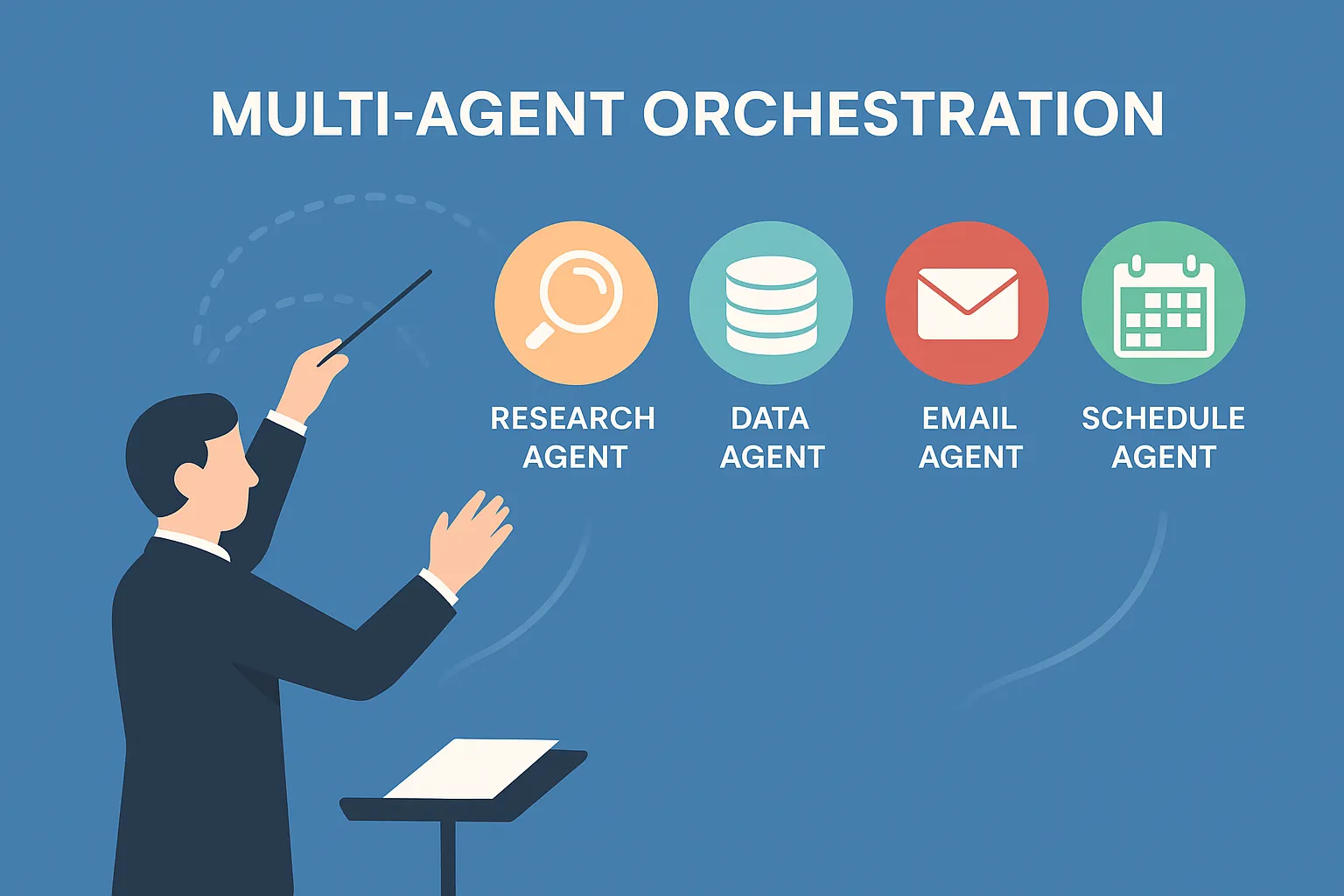
- Ontology + Data Agent + Operations Agent: The ontology grounds agents in shared business semantics and rules. Data Agents retrieve context and reason across domains in your language. Operations Agents recommend and trigger governed actions based on your defined business logic.
05 -- What's Next
This Is Preview -- Act Before It Becomes Mainstream
Fabric IQ is currently in preview, which means early adopters have a rare window to shape how this capability lands in their organization -- before it becomes table stakes and the competitive pressure to have governed, AI-ready data intensifies across every industry.
Teams that build their ontology foundation now will be months ahead when IQ reaches general availability. The organizations that will win in the AI era aren't necessarily the ones with the most data. They're the ones with the most coherent data. Fabric IQ is the architecture to get there -- and Armely is the partner to take you there, fast.
|
5 Integrated Fabric items |
1x Define once, shared everywhere |
Infinite Downstream tools, one truth |
|
READY TO UNLOCK THE FULL POWER OF YOUR DATA? Armely Helps You Every Step of the Way From Microsoft Fabric and AI strategy to full implementation and managed support -- Armely is your end-to-end partner for Data & AI excellence. |
|||
|
AI SERVICES |
|||
|
AI Consulting Define your AI strategy, identify high-value use cases, and build a practical roadmap for deployment. |
AI Advisory Ongoing strategic guidance to keep your AI investments aligned with business objectives and governance standards. |
Generative AI Design and deploy enterprise GenAI solutions -- RAG pipelines, copilots, intelligent search, and document automation. |
AI PoC Starter Move from idea to proof-of-concept fast. Armely's structured PoC framework de-risks AI adoption with validated outcomes. |
|
DATA SERVICES |
|||
|
Microsoft Fabric Full-lifecycle Fabric implementation: Lakehouses, pipelines, semantic models, Fabric IQ ontologies, and Real-Time Intelligence. |
Data Science & Analytics End-to-end analytics engineering -- from raw data to insight-ready models, dashboards, and ML-powered applications. |
Data Strategy Assess your data maturity, define your architecture roadmap, and align your data investments with business priorities. |
Databricks & Snowflake Expert implementation and optimization of leading cloud data platforms, with seamless integration into your broader stack. |
|
DIGITAL TRANSFORMATION |
|||
|
Power Platform Power Apps, Power Automate, Power Pages, and Power Virtual Agents -- rapid low-code solutions that drive operational efficiency. |
Microsoft Dynamics 365 CRM and ERP implementations that connect your customer, sales, and operations data into a single platform. |
SharePoint & RPA SharePoint Online for governed collaboration, and Robotic Process Automation to eliminate manual, repetitive workflows. |
API & Integration Secure API data access and system integration to connect your applications, data sources, and business processes. |
|
MANAGED SERVICES |
|||
|
SQL Server Support Proactive 24/7 management, performance tuning, patching, and incident response for your SQL Server environments. |
Applications Support Ongoing managed support for your business applications -- ensuring uptime, performance, and continuous improvement. |
Data Platform Ops Monitoring, optimization, and governance of your cloud and hybrid data platforms, so your team can focus on outcomes. |
Fabric Capacity Planning Right-size your Microsoft Fabric investment from day one with Armely's proven capacity estimation framework. |
|
PREVIEW WINDOW IS OPEN NOW -- DON'T WAIT Don't Let Your Competitors Get There First Whether you are starting your Fabric IQ journey, modernizing your data platform, deploying generative AI, or streamlining operations -- Armely has the expertise to take you from strategy to production, fast. The organizations building their data and AI foundations today will outperform those that wait. The time to act is now. Book a Free Strategy Session | Start Your AI Readiness Assessment | Talk to Our Team armely.com/contact | info@armely.com | +1 972 460 0643 |
About Armely
Armely LLC is a Dallas-based Microsoft partner specializing in Data, AI, and Digital Transformation services. We help organizations across healthcare, energy, transportation, education, and the public sector design, build, and operate data platforms that are reliable, governed, and AI-ready. From Microsoft Fabric and Generative AI to Power Platform and Managed Services, Armely delivers end-to-end digital excellence.
armely.com | info@armely.com | +1 972 460 0643 | 17400 Dallas Pkwy, Suite 111, Dallas TX 75287